
Written by webtechs

Summer Garden Care In Arizona For Desert Plants And Landscapes

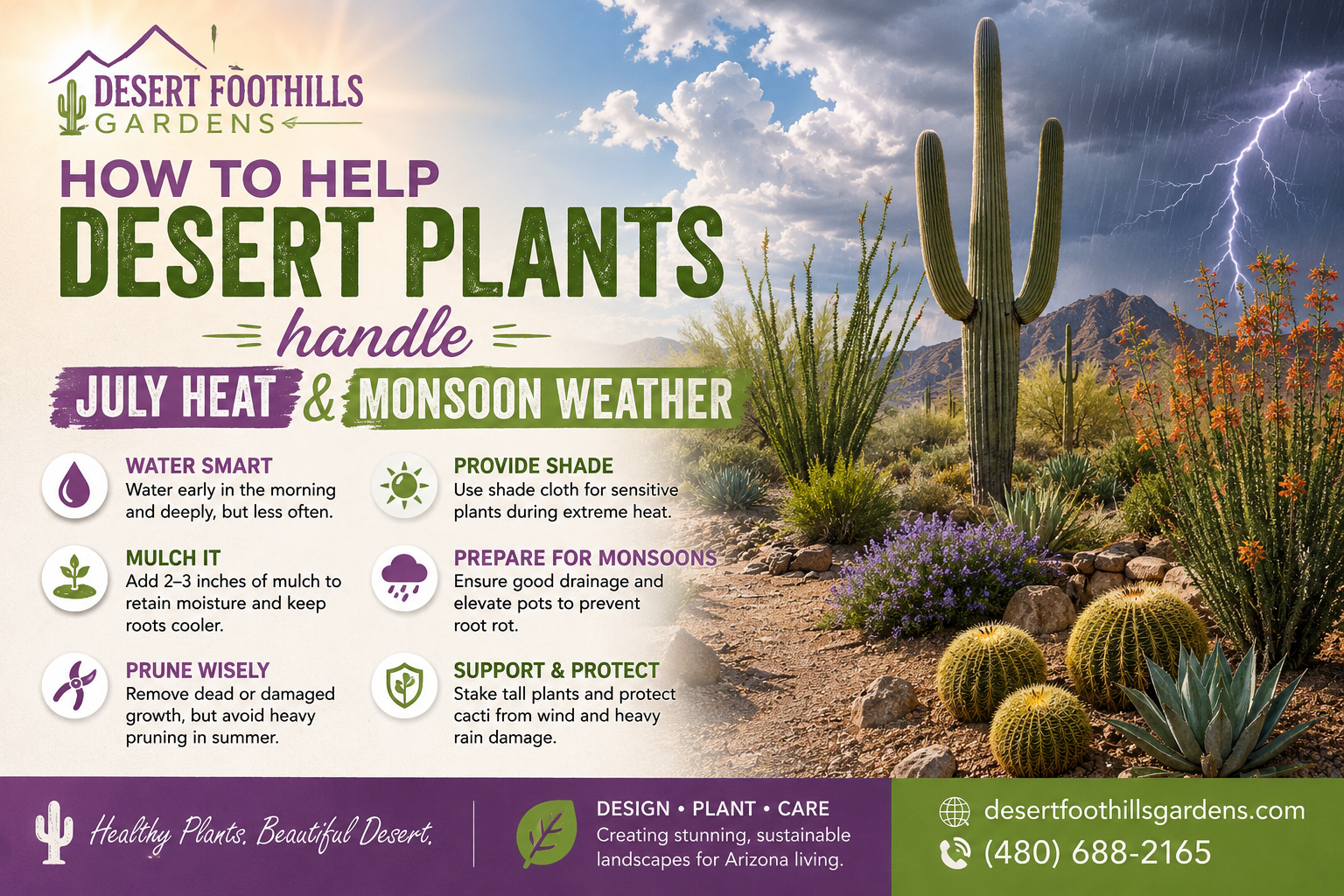
June is when an Arizona garden starts to show what is really working.

Some plants handle the heat without much complaint. Others begin to wilt, fade, burn, or look tired by the middle of the afternoon. Even plants that are considered desert friendly can struggle if they were planted too recently, watered poorly, or placed in the wrong part of the yard.

That is why summer garden care in Arizona needs a slightly different mindset. The goal is not to force a lush green garden to behave like it would in a cooler climate. The goal is to work with the desert, choose the right plants, and help the landscape stay healthy through the hottest part of the year.

Desert Foothills Gardens can help homeowners think through plants, watering, seasonal care, and desert landscape choices that make sense for Arizona conditions.

Water Deeply Instead Of Constantly

One of the most common summer garden mistakes is shallow watering. A quick sprinkle may make the surface look damp, but it does not always reach the root zone where plants need moisture most.

Deep watering is usually better for many trees, shrubs, and desert plants. It encourages roots to grow deeper, where the soil stays cooler and moisture lasts longer. The exact watering schedule depends on the plant, soil, sun exposure, slope, and age of the landscape.

New plants need closer attention than established plants. Even a heat tolerant plant may need extra care during its first summer while roots are still developing.

Watch For Heat Stress

Plants do not always fail suddenly. They usually give warnings first.

Curling leaves, crispy edges, dull color, dropped flowers, yellowing leaves, limp stems, and scorched tips can all be signs that a plant is under stress. Sometimes the issue is not enough water. Other times it may be too much water, poor drainage, reflected heat from walls, or a plant that is simply in the wrong location.

In June, it is smart to walk the yard early in the morning and look closely. Morning is better because some plants naturally look tired in late afternoon heat, then recover overnight.

Use Mulch To Protect Soil

Mulch can make a real difference in Arizona gardens. It helps slow evaporation, protects soil from direct sun, moderates soil temperature, and can reduce weed growth.

Organic mulch works well around many trees, shrubs, and planting beds. Rock can also be useful in desert landscapes, but it can hold and reflect heat. Around sensitive plants, too much rock in full sun may make the root area hotter than expected.

The right choice depends on the plant and the design of the yard.

Choose Plants That Belong In The Desert

A summer garden is easier to maintain when the plant palette fits the climate. Desert adapted trees, shrubs, succulents, cacti, perennials, and groundcovers can provide color, structure, texture, and seasonal interest without fighting the environment every week.

That does not mean the garden has to look plain. Arizona landscapes can be full of color and personality when plants are chosen for the right space.

Before planting in June, homeowners should think carefully about exposure, irrigation, mature size, reflected heat, and how much care the plant will need through summer.

Contact Desert Foothills Gardens

If your Arizona garden is struggling in the heat, or if you are planning a more desert friendly landscape, Desert Foothills Gardens can help with plant selection and seasonal garden guidance.

June is a good time to make smart adjustments before the worst summer stress arrives. With the right watering habits, plant choices, mulch, and care, a desert garden can stay attractive and healthy through the heat.

Call Desert Foothills Gardens today to learn more about Arizona summer garden care and desert landscape plants.

References:

https://desertfoothillsgardens.com/

https://extension.arizona.edu/sites/extension.arizona.edu/files/pubs/az1298.pdf

https://extension.arizona.edu/sites/extension.arizona.edu/files/pubs/az1150.pdf

https://www.amwua.org/landscape/watering-guide

https://www.amwua.org/plants

Summer Desert Landscaping in Phoenix

Desert Foothills Gardens Nursery, Inc. has been Phoenix’s source for design, plan selection, and maintenance since 1985. We have a team of experts that help with the overall plan for your desert landscape that includes plant selection, design, irrigation, and water management strategies. If you are interested in seeing how Desert Foothills Gardens Nursery, Inc. could provide a low maintenance and low water use landscape at your home or business either stop our nursery at 33840 N. Cave Creek Rd. in Cave Creek or give us a call at 480-488-9455.


Written by webtechs

What Planting Zone is Phoenix, AZ

Phoenix, Arizona is primarily in USDA Plant Hardiness Zone 9b, with some parts falling into Zone 10a depending on elevation and urban heat effects.

🌱 What This Means for Planting:

  • Zone 9b:

    • Avg. annual minimum temperature: 25°F to 30°F

    • Most of Phoenix is in this zone.

  • Zone 10a (warmer microclimates):

    • Avg. annual minimum temperature: 30°F to 35°F

    • Found in central/urban Phoenix or south of the city.

🌼 What You Can Grow in Zone 9b/10a:

✅ Fruit & Citrus Trees:

  • Lemons, limes, oranges, figs, pomegranates, dates

✅ Vegetables:

  • Fall/Winter: Lettuce, broccoli, carrots, peas

  • Spring/Summer: Melons, okra, eggplant, peppers

✅ Herbs:

  • Basil, oregano, thyme, rosemary, mint

✅ Ornamentals & Trees:

  • Bougainvillea, lantana, Texas sage, palo verde, mesquite

🗓️ Planting Calendar Tip:

Because of Phoenix’s desert climate, fall and early spring are the best times to plant — avoid mid-summer plantings unless you’re using shade cloth and drip irrigation.

Here’s a Phoenix-Specific Planting Calendar for USDA Zone 9b/10a, plus a list of drought-tolerant plants that thrive in your desert climate.

🌵 PHOENIX PLANTING CALENDAR (Zone 9b/10a)

🥬 Cool-Season Crops (Plant: October–February)

  • Lettuce

  • Kale

  • Spinach

  • Broccoli

  • Carrots

  • Beets

  • Onions

  • Garlic

  • Peas

  • Radishes

🌟 Tip: Best germination in October–November. Use row covers in Dec–Jan if frost hits.

🍅 Warm-Season Crops (Plant: Mid-February–April)

  • Tomatoes (start indoors in Jan, transplant in Feb/March)

  • Peppers

  • Eggplant

  • Squash (zucchini, crookneck)

  • Melons (cantaloupe, watermelon)

  • Beans (green beans, black-eyed peas)

  • Corn

  • Cucumbers

🌡️ Note: Shade cloth helps protect tender starts from late spring heat.

🌞 Hot-Season Crops (Plant: July–August)

For monsoon planting (heat-loving crops that can germinate fast in warm soil):

  • Okra

  • Cowpeas

  • Armenian cucumbers

  • Sweet potatoes

  • Malabar spinach

🍋 Fruits & Citrus (Plant Trees: Fall or Spring)

  • Citrus: Lemon, orange, lime, grapefruit (plant Feb–April or Oct–Nov)

  • Pomegranate (best planted fall to early spring)

  • Fig

  • Jujube

  • Olive

  • Date palm (needs space and heat)

🌼 DROUGHT-TOLERANT LANDSCAPE PLANTS FOR PHOENIX

🌺 Flowering Shrubs & Perennials

  • Lantana – colorful, attracts butterflies

  • Texas Ranger (Leucophyllum frutescens) – purple blooms after monsoons

  • Desert Ruellia – purple flowers, low water

  • Red Bird of Paradise – bright orange-red flowers

  • Chuparosa – hummingbird favorite, red tubular flowers

🌳 Trees

  • Palo Verde (AZ state tree) – yellow blooms, low water

  • Desert Willow – fast-growing, trumpet flowers

  • Mesquite (Native types) – shade provider, deep-rooted

  • Ironwood – beautiful lavender flowers in spring

🌵 Succulents & Cacti

  • Agave

  • Aloe Vera

  • Ocotillo

  • Barrel Cactus

  • Golden Torch Cactus

🌿 Groundcovers & Grasses

  • Damianita – yellow flowers, compact

  • Desert Marigold – bright and fast-spreading

  • Deer Grass (Muhlenbergia rigens) – native, ornamental

  • Trailing Rosemary – fragrant, edible, heat-tolerant

Here’s a Phoenix-Specific Drip Irrigation Schedule tailored to Zone 9b/10a, factoring in the desert climate, plant type, and season. This guide helps you water efficiently using drip emitters while avoiding overwatering or plant stress.

💧 PHOENIX DRIP IRRIGATION SCHEDULE

(For native & desert-adapted plants and non-natives)

🌡️ General Guidelines by Season

Season Frequency Depth of Watering
Winter (Dec–Feb) Every 14–30 days Deep soak (18–24″)
Spring (Mar–May) Every 7–14 days Deep soak (18–24″)
Summer (Jun–Sept) Every 3–7 days (native)
Every 2–3 days (non-native)
Deep soak (18–24″)
Fall (Oct–Nov) Every 7–14 days Deep soak (18–24″)

Note: Native plants tolerate longer gaps. Adjust for soil type: sandy = more frequent, clay = less frequent.

🪴 By Plant Type (Drip Irrigation System)

🌳 Trees (Desert & Non-Desert)

  • Emitters: 2–4 emitters, 2–4 GPH

  • Watering zone: Near dripline (not trunk)

  • Schedule:

    • Summer: Every 7–10 days

    • Winter: Every 21–30 days

🌿 Shrubs

  • Emitters: 1–2 emitters, 1–2 GPH

  • Schedule:

    • Summer: Every 5–7 days

    • Winter: Every 14–30 days

🌼 Groundcovers / Perennials / Flowers

  • Emitters: 1 emitter, 0.5–1 GPH

  • Schedule:

    • Summer: Every 3–5 days

    • Winter: Every 10–14 days

🍋 Citrus & Fruit Trees

  • Emitters: 4+ emitters, 2–4 GPH

  • Schedule:

    • Summer: Every 7 days (long soak ~2 hours)

    • Winter: Every 14–21 days

🌵 Cacti & Succulents

  • Emitters: 1 emitter, low flow (0.5 GPH)

  • Schedule:

    • Summer: Every 21–30 days

    • Winter: Rarely if at all

🔁 How Long to Run Your System?

Calculate Time:

Time (minutes)=(Gallons NeededFlow Rate (GPH))×60\text{Time (minutes)} = \left( \frac{\text{Gallons Needed}}{\text{Flow Rate (GPH)}} \right) \times 60

Example:
A shrub needs 4 gallons
You have 2 emitters @ 1 GPH

42=2 hours (120 minutes)\frac{4}{2} = 2 \text{ hours (120 minutes)}

🧠 SMART TIPS

  • Use a soil probe (or screwdriver): If it goes in easily 6–10″, you’re watered enough.

  • Always water at night or early morning to reduce evaporation.

  • Add mulch around emitters to keep soil moist longer.

  • Check for emitter clogs monthly — mineral buildup is common in Phoenix.

Desert Landscaping in Phoenix

Desert Foothills Gardens Nursery, Inc. has been Phoenix’s source for design, plan selection, and maintenance since 1985. We have a team of experts that help with the overall plan for your desert landscape that includes plant selection, design, irrigation, and water management strategies. If you are interested in seeing how Desert Foothills Gardens Nursery, Inc. could provide a low maintenance and low water use landscape at your home or business either stop our nursery at 33840 N. Cave Creek Rd. in Cave Creek or give us a call at 480-488-9455.