

Written by webtechs

Best Desert Plants for Reflected Heat in Phoenix Landscapes
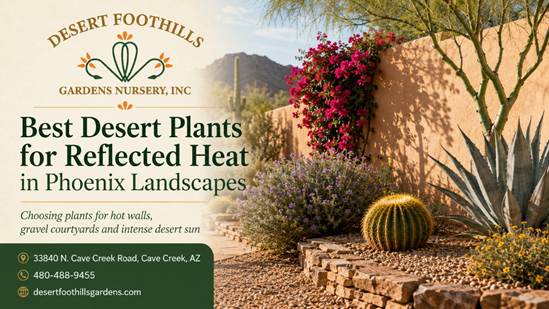
Best Desert Plants for Reflected Heat in Phoenix Landscapes

A west facing wall, gravel courtyard or pool deck can create one of the harshest planting areas in a Phoenix yard. By August, the plant receives direct afternoon sun, then absorbs additional heat reflected from stucco, block, glass, stone or pavement. A species labeled for full sun may still struggle when it is placed in that concentrated heat.

The solution is not to leave the area bare. It is to choose plants that tolerate desert sun, provide enough room for mature growth and receive the right irrigation while they become established.

Understand Reflected Heat Before Choosing Plants

Reflected heat creates a hotter microclimate than ordinary full sun. South and west facing walls are especially demanding, while light colored walls, artificial turf, gravel and concrete can increase the temperature around nearby foliage.

Watch the area through the afternoon. Note how long it receives direct sun, whether a wall blocks airflow and where roof or pavement runoff collects during monsoon storms. A narrow bed beside a hot wall may need tougher plants than an open section of the same yard.

Choose Plants Proven in Desert Conditions

Bougainvillea is a strong option for a hot wall when there is room for its mature size. It produces vivid color, handles intense sun and can be trained as a shrub or vine. Its thorns and vigorous growth make careful placement important.

Desert ruellia offers purple flowers and a softer form while tolerating west facing exposure. Yellow bells bring bright trumpet shaped blooms, and Texas sage provides silvery foliage with flowers that often appear around humid summer weather.

Agaves, yuccas and desert spoon add structure without requiring constant trimming. Golden barrel cactus, prickly pear and other desert adapted cacti can also work well where drainage is good and people will not brush against spines.

Use Trees and Larger Shrubs to Reduce Heat

A small tree or tall shrub can protect less tolerant plants by creating afternoon shade. Placement matters because roots, branches and mature width must fit the available space.

Cascalote tolerates hot locations and reflected heat while providing seasonal yellow flowers. Desert willow, palo verde and selected acacias may also suit low water landscapes when the site provides enough room. The best choice depends on the yard, nearby structures and the amount of litter the homeowner is willing to manage.

Planting layers can improve the whole area. A tree provides shade, medium shrubs soften the wall and low plants reduce glare from gravel or bare soil.

Do Not Treat Drought Tolerant as No Water

Newly installed desert plants still need regular irrigation. Their roots must expand into the surrounding soil before they can handle longer periods between watering.

Water deeply enough to reach the developing root zone instead of applying a small amount every day. As the plant becomes established, irrigation can usually become deeper and less frequent. Keep emitters near the outer root area as the plant grows rather than leaving them against the trunk forever.

Check drainage before planting cactus or agave. Water that remains around the crown can cause serious problems, particularly when summer heat is followed by heavy monsoon rain.

Leave Enough Space From Walls and Pavement

Crowding a plant against a wall can trap heat and restrict its natural form. Read the expected mature width, then allow room for air movement, pruning and access to irrigation.

Keep thorny plants away from walkways, gates and utility equipment. Large agaves should not be planted where their leaves will eventually extend into a path. Cacti near driveways need enough setback to protect passengers opening vehicle doors.

A thoughtful plan looks less crowded at installation and better after several years.

Visit Desert Foothills Gardens for Phoenix Desert Plants

Desert Foothills Gardens Nursery offers desert trees, shrubs, cactus, succulents, pottery, fountains, boulders and landscape design and installation for Cave Creek, Carefree, North Scottsdale, Phoenix and surrounding communities. The nursery team can help match plants to sun exposure, reflected heat, mature size and the style of your property. Visit 33840 N. Cave Creek Road in Cave Creek or call 480-488-9455 to discuss your landscape and current plant availability.
Written by webtechs

Principles of Landscape Design

Are you a homeowner who appreciates having your garden looking hearty and healthy? Sometimes it can be challenging to make sure that your flowers and plants grow properly, but you don’t need to be an expert gardener to have a beautiful garden. Fortunately for those of us who haven’t developed our green thumbs yet, there are a couple of tricks that can help! One of these tricks includes using compost or mulch in your garden. On the other hand, there are a couple of questions that need to be answered first. Which one is best and what are the differences between them?

Contrast and Harmony

Contrast will help enhance particular elements in your landscape design, while harmony helps elements in a landscape design look unified. Contrasting elements also grab your guest’s attention when they’re placed side by side. Contrast and harmony are attained by the proximity of the elements of art or using complementary colors beside each other.

Proportion

The size of an element in relation to another is known as proportion. When designing a landscape, proportion is probably the most obvious of all but still will require some thought and planning. You need to make sure that the elements that you use in your landscape design have the proper proportions.

  • It is able to maintain the moisture in the soil. Your plants will find it easier to get water and moisture, as it will not dry up as fast. Additionally, more nutrients will be retained in the soil, making it rich and easier for your plants to grow.
  • Mulch naturally fights weed growth. When undesirable seeds are blown into a part of your garden that is covered in mulch, the weeds can’t take root and grow. In general, this will benefit you, as you won’t have to spend time and effort weeding your garden.
  • Mulch helps manages temperatures so that plants have a better chance of thriving outdoors. In colder temperatures, mulch can safeguard roots and lowers the probability of plants being uprooted due to the contracting soil. In warmer temperatures, the roots are kept healthy and cool.

Balance

Balance is simply a feeling of equality. 2 basic types of balance in landscape design are symmetrical and asymmetrical balance. Using symmetrical balance, 2 sides of the landscape will coincide with each other. When using asymmetrical balance, the landscape design is balanced utilizing various elements and features that have a similar fictional weight.

Color

Color provides your landscape design with the aspect of real life. Warmer colors seem to advance, making a landscape features seem closer. While cool colors like greens and blues seem to move away and shows perspective.

Transition

Transition is simply just a gradual shift. Transition in landscape design is shown by gradually varying plant sizes or the intensity of color. Transition can also be applied to texture, the size and shape of foliage or other design elements.

Line

In landscape design line is the beginning of all design elements. Lines are used just about everywhere including designing flower beds, walkways and entryways, texture and perspective. Lines are also used to give an illusion of distance and depth.

Unity

Unity in landscaping is the consistency and repetition in your design. Applying consistency to create unity by gathering various elements of a landscape together to create a common theme. Repetition is used to bring unity into your design by repeating associated elements which incorporate decor and plants into the design.

Repetition

Repetition is directly associated to unity. It’s good to have various elements and forms in a landscape but repeating the same elements can give your design several issues. If there are too many objects that are not associated with each other can cause your design look muddled and unplanned. Also, try to avoid overusing an element because overusing an element can make your design seem uninteresting and boring.

Landscape Design Conclusion

When you use the 8 principles of landscape design, designing your landscape can be a delightful way to release your creative side. The usage of color, contrast, and lines all can help affect the design of your landscape. When designing a new landscape, or enhancing the one you have currently, the experts at Desert Foothills Gardens Nursery, Inc. know how to incorporate design to provide you with a practical backyard that is also pleasing to the eye.

Desert Foothills Gardens Is A Landscape Design Company in Cave Creek

Desert Foothills Gardens Nursery offers landscape design in Cave Creek, Arizona. If you are looking for the best quality, widest selection, and healthiest plants to put in your landscape or garden in the Phoenix area, Desert Foothills Gardens Nursery is your #1 source. If you would like to view our desert plant selection stop by our nursery in Cave Creek or give us a call at (480) 488-9455.